The story
A childhood coach, an old shoebox, and a collection that found its way back into my life.
When I was about eight years old, I began playing youth soccer in Sacramento’s Land Park Soccer Club. My first team was called the Volcanoes, and our coach was a man named Art Scotland. Long before he became a prominent and highly respected California judge, Art was just “Coach,” but he quickly became much more than a childhood soccer mentor. Most of the kids on that team remained close friends throughout high school, including Art’s stepson, Josh Wolcott. I spent countless summer afternoons in their swimming pool and plenty of nights sleeping over at their house. Art was always one of the good guys, relating naturally to all of us and remaining a steady part of our lives even after our organized soccer days were over. He occasionally joined our annual Thanksgiving football games—and these weren’t casual games of touch football. We played tackle.
When I was around fifteen, Art called and asked if I would come over to look at his childhood baseball-card collection. He knew how deeply I had gotten into collecting and wanted me to give him some idea of what his cards might be worth. I remember riding my bike to his house because I wasn’t old enough to have my driver’s license yet. When I arrived, Art pulled out an old shoebox and flipped open the lid. Inside was an absolute treasure trove of baseball cards, almost all from the 1950s. They were organized by team and looked as though they had barely been touched since Art was a kid.
We began pulling out the cards, and my jaw practically hit the floor. Mickey Mantle, Ted Williams, Hank Aaron, Willie Mays, and seemingly every other star of the era. Even more remarkably, many of them were in pretty nice condition considering their age and the fact that they had spent decades stored raw in a shoebox. This was long before anyone carried recent sales data around on a phone, so we did what collectors did at the time: we opened the latest Beckett price guide and began looking up the cards.
After spending a while admiring the collection and helping Art estimate some values, I eventually prepared to ride home. Before I left, he reached into the box, pulled out a 1959 Topps Brooks Robinson, and handed it to me as “payment” for coming over. I seem to remember Art saying that he might try to sell the collection, but after that afternoon, I didn’t hear much more about the cards.
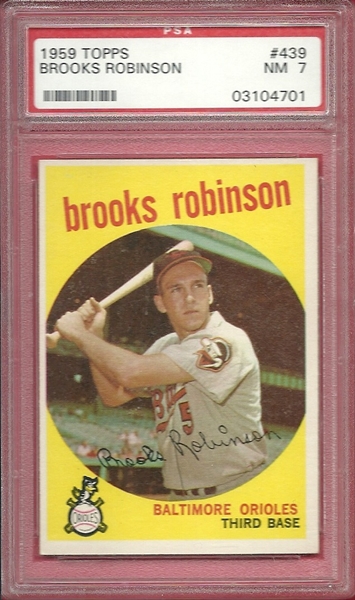
Years later, as professional card grading was beginning to gain traction, I included that Brooks Robinson in one of my earliest submissions to PSA. It came back graded PSA 7—an excellent grade for a card that old, especially one that had spent most of its life loose in a shoebox. I kept it in my collection for decades, and eventually it earned a place in one of the display cases on the wall of my office. It remained a tangible connection to Art, my childhood, and that unforgettable afternoon at his house.
Then, sometime around 2022, I was playing poker with a group of friends when one of them mentioned that he worked with Art. I immediately began telling him about Art—how he had been my soccer coach, how I had practically grown up at his house, and what a genuinely good man he was. Then I added, almost as an afterthought: “Ask him if he still has his baseball cards.”
Quite a bit of time passed. Whenever I saw my friend at poker, I reminded him to ask Art about the collection. Finally, in early 2025, he told me that he had asked. Art still had the cards. Most of them, anyway. He had sold a few over the years, but the majority of the collection remained intact. I got Art’s phone number and sent him a text. I told him that I still remembered the day he showed me those cards and that I continued to display the Brooks Robinson he had given me. I said that if he ever wanted to look through the collection again, I would love to join him. He responded almost immediately, and we set a date to meet.
When I arrived at his house in the spring of 2025, the old shoebox was gone. The cards were laid out across a table, and most were now protected in plastic top loaders. Several still had old price stickers attached—the remnants of an earlier attempt to sell them through a dealer. Looking through the cards transported me directly back to that afternoon when I was fifteen. They were every bit as wonderful as I remembered.
As we talked, Art told me how he had assembled the collection. He grew up in Sacramento’s Land Park neighborhood, where he still lives today. Whenever he received his allowance as a boy, he would immediately spend it on packs of baseball cards. These weren’t cards that had been assembled recently through auctions, card shows, or dealers. They were his cards. Art had pulled them from packs as a child, organized them by team, and carefully carried them with him through the following seven decades. With very few exceptions, the collection had never even left Sacramento.
After we had looked through everything, I offered to help Art create a display that he could hang in his office. He wasn’t interested. Instead, he asked whether I would help him sell the collection. I agreed, thinking I would take the cards home, research their values, and help find buyers.
Without a moment’s hesitation, Art began gathering everything up and handed the entire box to me. “Just let me know what you get,” he said.
I was stunned by the absolute trust he placed in me. He was handing over a lifetime of memories to the boy he used to coach, without an inventory or an agreement.
I brought the collection home and spent hours looking through every card. It didn’t take long for me to realize that I wasn’t going to be able to sell them to strangers. I told my wife, Suzie, “I need to buy these. I have to have them.” She understood immediately and agreed.
After several days of researching values, I sent Art another message: “I’ve fallen in love with them—all of them. Can I make you an offer?”
I spent a lot of time researching the values to come up with an equitable offer for the entire collection. When I presented it, Art accepted without hesitation, stating that if I thought it was fair, he was good with it. A few weeks later, we met for lunch to complete the purchase. It was wonderful to spend that time together after so many years, and it gave Art a chance to see that the collection was going to a home where it would truly be cherished.
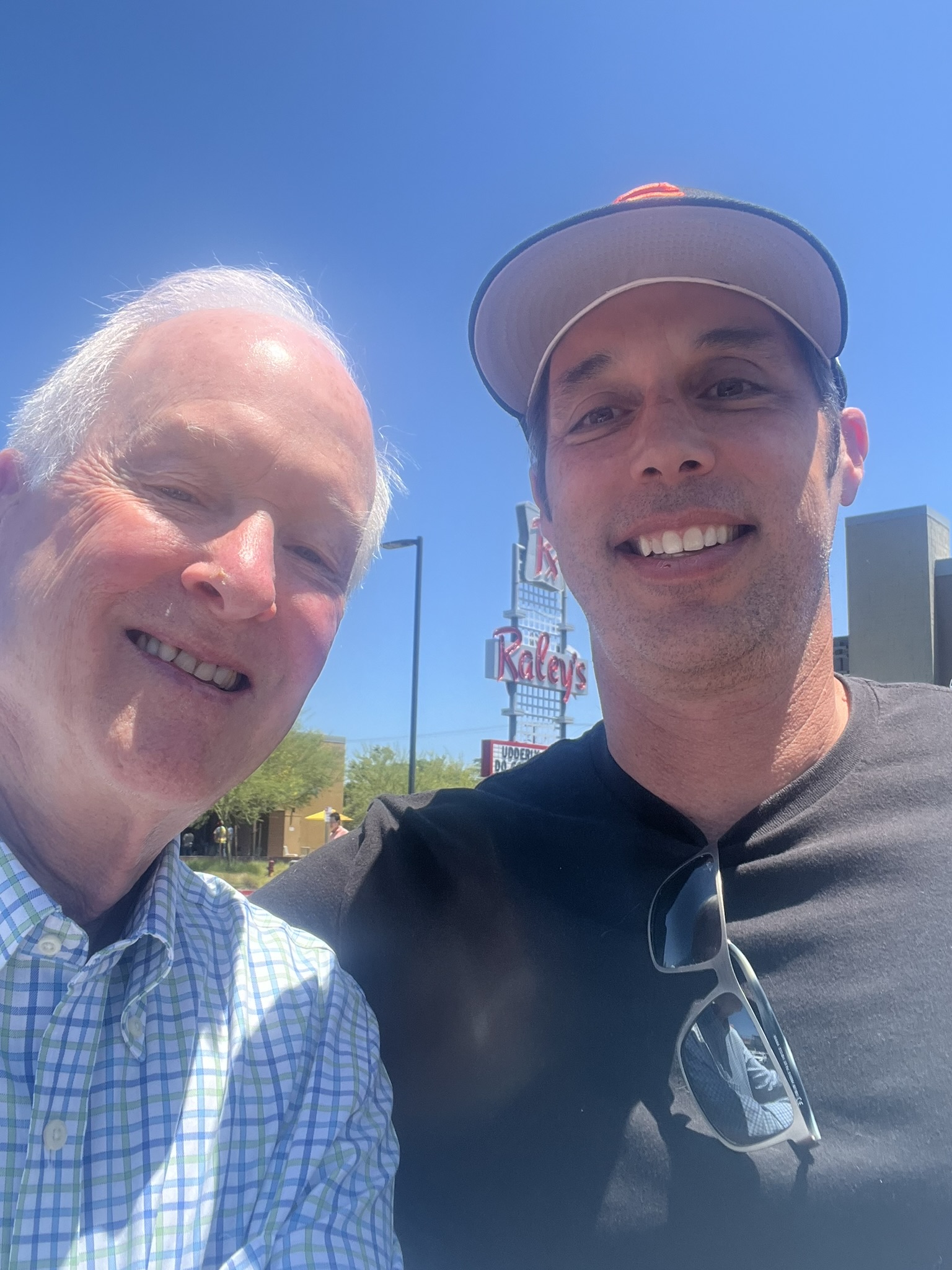
To the legal world, Art Scotland was a prominent and highly respected California judge. But to me, he will always be the man who coached the Volcanoes, welcomed a group of neighborhood kids into his home, joined our tackle football games, and ultimately entrusted me with the cards he had treasured since childhood.
Among those cards, one stands above all the others: Art’s 1959 Topps Willie Mays.
The incredible story behind it took place on April 14, 1986. Art was working as the Cabinet Secretary at the California State Capitol when Governor George Deukmejian officially declared it “Willie Mays Day” in California. Hearing that the baseball legend was in the building, Art rushed home during his lunch hour, dashed into his garage, and retrieved the box of cards that had been sitting on a shelf. He found his childhood Willie Mays card, raced back to the Capitol, and managed to have Willie sign it right there. Then Art took the card home, returned it to the shoebox, and left it there for the next several decades.
That card now hangs on my wall, professionally authenticated but still carrying every bit of its original history. It was pulled from a pack by a Sacramento boy in the 1950s, preserved by him into adulthood, carried to the State Capitol to be signed by Willie Mays himself, returned to its shoebox, and eventually entrusted to someone Art had first met as an eight-year-old soccer player. It is my favorite card in the entire collection.
The cards displayed here are valuable to me for reasons that could never be captured in a price guide or auction result. Together, they tell the story of a childhood collector, a lifelong friendship, and a collection that traveled only a few miles—but more than seventy years—to reach its new home.
This is The Art Scotland Collection.